Accessibility Solutions to Think About for National Assisted Living Week

Elderly man and young boy smiling outdoors, showing family bonding, related to A-Plus Air Conditioning home comfort services.

Make Your Home Accessible for Grandparent’s Day

This year, the 11th of September marks Grandparent’s Day. Every year, Grandparent’s Day is celebrated as the beginning of National Assisted Living Week to celebrate and bring awareness to those living in assisted living due to their limitations in old age. As people age, homes become less accessible to live in and more of a liability. To get around this, many people choose to live in assisted living facilities to overcome their limitations. For those who don’t wish to leave home, many options can make homes more accessible for the elderly.

This year, take a moment to think about the accessibility of the homes of the elderly. Given the option, most older people would choose to stay in their homes if they could. Here are a few ideas to make homes more accessible for the elderly.

Bathroom Accessibility Upgrades
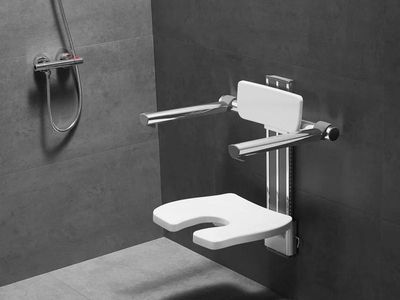
Wall-mounted shower seat with grab bars for enhanced bathroom accessibility for the elderly, promoting safety and mobility.Bathrooms are the room in the home that is most responsible for household accidents. Every year, thousands of injuries in bathrooms occur, even among the able-bodied. How much worse could it be for someone with hampered mobility?

A great place to start when thinking about bathroom accessibility upgrades is the shower or bathtub. Among the elderly, getting in and out of a tub or slipping on the wet tile while stepping out of the shower are two of the greatest hazards. Some simple ways to overcome this are:

Another common hazard in the bathroom is a lack of reinforced railings for balance and maneuvering. Installing a railing around toilets and bathtubs allows those with limited mobility to more easily and confidently move around the space.

Stair Accessibility Solutions

For too many seniors, a multi-story home impedes their way of life once they can no longer confidently live alone. Often they will try to maintain independence in the house where they raised a family despite running the risks of going up and down stairs. Luckily there are ways to accommodate multi-story homes so seniors can continue living independent lives at home.

Stair elevators (or stair lifts) and ramps are the best solutions to overcome mobility issues and risks like stairs. Both make traveling around the home easier and safer. Stair elevators are automatic, powered devices that safely transport seniors upstairs, while ramps are used for small elevation changes like porch steps.

Door Accessibility Solutions

Lever door handle on a white door, illustrating accessibility solutions for seniors and those with mobility issues.The older people get, the more likely they will have mobility issues. This can often mean being confined to a wheelchair or walker. A problem with wheelchairs and walkers is that doorways can impede them. The first way that doorways restrict those with limited mobility is the door knobs. When seniors use mobility assistance, their hands are always used for balance. This can make gripping a door handle and pulling the door a difficult action. Lever door knobs are a better choice because they can be more easily gripped.

A second way that doors inhibit accessibility is the width. Luckily, widening doorways is simple and can even add value to the home. In almost every case, doorways can be widened to 36 inches, which is the ADA standard for disability access for doorways.

About A-Plus Air Conditioning & Home Solutions

A-Plus Air Conditioning & Home Solutions is a local staple for home accessibility solutions for those with limited mobility. They offer flat-rate pricing and financing. Call them today for trusted aging-in-place services in Austin, TX.

Quick Facts About Heating Technology

Wooden letter blocks spell "STOP" on a clean background, representing A-Plus Air Conditioning's home service call to action.

The History of Central Heating

One of the first things needed to survive the dangers presented by nature is a good shelter from the elements. Humanity’s ancestors innately knew the struggles of surviving against nature. In modern society, it is easy to overlook the necessity that homes represent. Modern homes have become so much more than just a barrier between humans and the elements. 

Probably the thing that most separates modern dwellings from that of earlier societies is the ability for humans to heat their shelters. Cold has always been one of the things that make humans struggle and suffer, but in modern homes, humans are protected from the cold and even comforted by the environment that they can create for themselves. Here are some facts about the development of modern heating systems that people enjoy today. 

Who Invented Central Heating?

Hand holding a white card with a large black question mark, symbolizing inquiries about central heating and home improvement solutions.

Throughout history, humans made use of fire to warm themselves and they quickly learned how to bring fire safely inside their dwellings to take advantage of it. But, it wasn’t until the Roman Empire that humans figured out ways to heat their buildings indirectly. 

The earliest examples of central heating are the ruins of Roman baths that date back at least 2000 years. These baths were cunningly engineered to provide an activity for the empire’s wealthy citizens. The baths had simple but revolutionary designs. The floor of the bath was supported on pillars so that it was about two feet above ground level, similar to a crawl space. 

At one end of the opening below the floor, a fire was kindled and tended. The heat and smoke were drawn underneath the floor by cleverly placed flues that were built into the walls. This allowed temperatures inside the bath to reach up to 120 degrees. 

What Was the First Modern Heating Invention?

Up until the 1800s, heating a home was simple. Fuel was burned, heat was released, and the dwelling warmed up. It wasn’t until the Industrial Revolution that people started to use physics as a means to distribute heat. 

In the 1850s, Franz San-Galli invented the first hot water radiator. With the recent developments of steam power, he decided to harness that concept to help heat homes. The first radiator systems were similar to what is used today. Water was heated in a central boiler and pumped to radiators around the home to distribute heat. 

Then, in 1885, Dave Lennox further advanced home heating with the world’s first steel coal furnace. This invention moved heat through the home by the process of natural convection. It carried warm air up to various rooms in the house from a basement furnace through a series of ducts. 

When Did Thermostats Come Into Play?

The most important part of a heating system is the thermostat. Without a thermostat, a home’s occupants have no way of actually adjusting the temperatures. The first thermostat was invented in 1830 before most buildings were even outfitted with heating systems. The first thermostats were made of two dissimilar metals joined together that bent when heated. 

Metal type blocks spelling "WHEN?" representing the historical inquiry into thermostat invention dates in home heating systems.

The technology for thermostats wasn’t recognized for its value in central heating until 1885 when electric thermostats were used to signal servants to stoke the fires when the room got too cool. Some systems had elaborate pulley systems that would allow users to open or close flues remotely. But, thermostats wouldn’t come into popular usage in most buildings until about 50 years later. 

About A-Plus Air Conditioning & Home Solutions

A-Plus Air Conditioning & Home Solutions is a home renovation and heating contractor in Austin. With a commitment to environmentally-friendly solutions, they work with homeowners to help them understand the best and greenest technology to heat and cool their homes. They have over 40 years of successful service and are still a family-owned business that takes pride in their personal touch.

The Most Frequently Asked Questions About UV Air Sanitizers

Air purifier with modern design and blue accents, showcased by A-Plus Air Conditioning & Home Solutions.

How UV Air Sanitizers Help Your Home

With everything going on in the world, more and more homeowners are looking for additional ways they can keep the air at home as clean as possible. One of the main ways they are achieving this is with a UV Air Sanitizer. But what exactly is a UV Air Sanitizer?

How does it work and can homeowners install one themselves? In this article, HVAC experts give answers to all these questions and help you find the ideal indoor air quality solution to keep your family safe.

What Is a UV Air Sanitizer?

A UV Air Sanitizer is either a portable or whole-home system that uses UV-C light to purify the air. A normal system can commonly kill up to 99.99% of most microorganisms, lowering airborne diseases caused by viruses, bacteria, molds, dust, and other particulate matter in the air.

Person in a business suit holding a sign with a question mark, representing inquiries about UV Air Sanitizers and air quality solutions.Systems come with a few common components that work together:


  • A Forced-Air Component
  • An Internal Chamber With a UV Light
  • One or Two Filters

Each component is equally important to purify the air. There are some systems out there that create ozone as a result of purifying the air.

There are many health benefits of using a UV Air Sanitizer in the home, especially for homes with people suffering from allergies and asthma. It can seriously improve the health of everyone in the house.

How Does It Work?

Essentially, a UV Air Sanitizer works simply by emitting UV-C light. Once that light touches a microorganism (like mold or bacteria) it gets to work. In almost every case, the UV light starts by destroying nucleic acids. With the nucleic acids destroyed, the DNA also fails. Very quickly, the microorganism becomes incapacitated or even starts to self destruct.

Woman with surprised expression, raising hands in confusion, illustrating uncertainty about air purification systems and their effectiveness.

The more time that the UV light in an air sanitizer spends touching a microorganism, the more it degrades. But how does that light get emitted from a UV Air Sanitizer? Most systems use a forced-air component in combination with a filter component. In most cases, a HEPA filter is used due to its extra filtration.

The sanitizer sucks air into it, which is then directed to a small chamber. Inside this chamber is the UV light. It then passes out of the system (sometimes passing through a second air filter) before re-entering the room, with 99.99% of bacteria, viruses, molds, dust, and germs inactive.

The UV Air Sanitizer Installation Process

Stylized text "Installation" emphasizing the installation process of UV Air Sanitizers in HVAC systems and portable units.Depending on the type of UV Air Sanitizer being installed, the answer varies. Whole-home UV Air Sanitizers are attached to the home’s existing HVAC unit. They are generally installed in the ductwork.

Portable UV Air Sanitizer units can be installed in the home anywhere they are needed. If purchased to help out with asthma and allergies, they should be placed closer to the people who need them.

In most cases, portable systems are not big enough to purify the air in the entire home, so multiple systems may need to be purchased and installed for full coverage.

However, both types of installation can be incredibly difficult and should always be done by a trained, HVAC professional with UV Air Sanitizer installation experience. Since it can play such an important role in the health and happiness of everyone in the home, it’s well worth it.

A-Plus Air Conditioning & Home Solutions

Located in Austin, Texas, A-Plus Air Conditioning & Home Solutions has been locally owned and operated since 1977. The licensed technicians focus on HVAC tune-ups and repairs, as well as home repairs and remodeling. A-Plus Air Conditioning & Home Solutions is accredited by the Better Business Bureau, along with being highly rated in Angie’s List and Google.